
The “bang” of January, 2026 has gone beyond New Year’s fireworks. A series of fatal shootings by U.S. immigration agents in Minneapolis jolted Americans already uneasy about the country’s trajectory.
Federal officers with Immigration and Customs Enforcement (ICE) and Border Patrol killed 37‑year‑old Renée Good during a raid, shot a man in the leg days later, and then fatally shot ICU nurse Alex Pretti within seconds of tackling him to the ground. Eyewitness videos and local officials say federal narratives don’t match what happened, and Minneapolis leaders have openly accused Washington of lying and overreaching.
Street protests have exploded across major U.S. cities, with chants to abolish ICE, calls for walkouts, and demands to pull federal agents out of local communities. The administration has largely closed ranks around the shooters, branding targets as “criminals” and “terrorists” while expanding aggressive deportation operations.

What powers do ICE agents have, and should we be worried about the erosion of civil liberties?
For many Americans, the images from Minneapolis are no longer isolated abuses but evidence of a creeping police state, and a warning that the boundary between “homeland security” and open authoritarianism is rapidly eroding.
This week Ink & Time provides a timely reminder that these fears, while legitimate, are not new. Nor are they unexpected.
Those who read, know that dystopian political thrillers have for over a century, imagined the risk of oligarchic overreach, aided and abetted by the deterioration in social conditions and institutional integrity. What follows is an except from the contemporary introduction to The Iron Heel, by Jack London, and a selection from Chapter XXI where we are introduced to the growing division between “The Mercenaries” and “The People of the Abyss.”
If you get the feeling that you’re now seeing this in the news, you’ll know why it’s time to revisit, and read, The Iron Heel.
Click to instantly download a digital copy of The Iron Heel (2025) from Ink & Time!
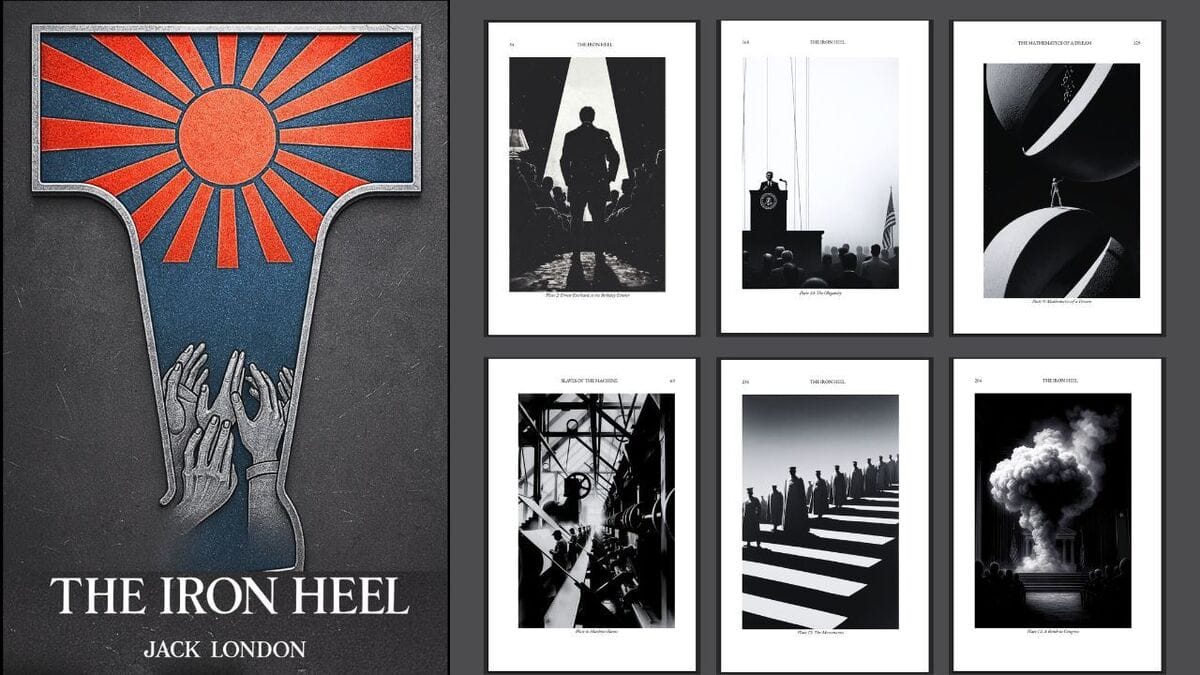
“Wealth, Power and the Slippery Slide into Oligarchy” (from the Introduction to The Iron Heel)
The transformation from wealth to oligarchy is a methodical process of consolidating power, culminating in a ruthless despotism. The process occurs in several key stages.
First, the decay of competitive capitalism and the march of economic consolidation. The narrative begins in an era of "rotten-ripe" capitalism, which, instead of evolving into socialism as many predicted, gives rise to the "monstrous offshoot, the Oligarchy."
Trusts eliminate competition. Large corporations use their superior capital and efficiency to drive small businesses and manufacturers to ruin. Businessmen at a dinner party describe how trusts absorb all their profits, effectively reducing them to the status of employees or forcing them into bankruptcy. Yet, they too would combine and consolidate if they could.
At times it reads like the story of Amazon entering small-town anywhere, a prediction unearthed from a time capsule.
As Ernest explains, ”There are three big classes in society. First comes the Plutocracy, which is composed of wealthy bankers, railway magnates, corporation directors, and trust magnates. Second, is the middle class, your class, gentlemen, which is composed of farmers, merchants, small manufacturers, and professional men. And third and last comes my class, the proletariat, which is composed of the wage-workers."
What does authoritarian overreach look like in a modern democracy?
Second, the seizure of political and governmental machinery. The Plutocracy transforms economic power into absolute administrative control. Law and courts become their tools. Thousands of lawyers twist and evade laws for the benefit of the wealthy. Courts are described as being "in the hands of the trusts," rendering them useless for those seeking justice against corporate power.
The government is run not by the people but by the "brain of the Plutocracy," described as seven small but powerful groups of men. Politicians are depicted as "the tool and the slave" of machine bosses, who are themselves owned by the capitalists. When the agrarian Grange Party legally wins elections in a dozen states, the Oligarchy-backed incumbents simply refuse to leave office, using the courts to tie up the situation indefinitely. Is it starting to sound like the 2020's?
How ‘law and order’ politics becomes a pretext for crushing dissent
Third, the creation of a loyal military force. To enforce its rule, the Oligarchy builds an unshakable military power. The regular army is systematically increased from 50,000 to 300,000 and then further. A secret law is passed that allows the government to draft any able-bodied male citizen into the militia and use them to crush uprisings. Under this law, citizens are forced, under penalty of death by court martial, to "shoot down their comrade-workers in other states."
Eventually, the old army and militia are replaced by the Mercenaries, a professional standing army a million strong. It becomes a "race apart," living in its own cities with special privileges, developing its own class consciousness, and serving as the Oligarchy's primary instrument of force.
Fourth, the division and subjugation of labor, the active fragmenting of the working class. The Iron Heel learns from the General Strike that unified labor is an existential threat. It counters by subsidizing the most powerful and essential unions: the railroad workers, machinists, and steel workers. "Favored unions" are given higher wages, shorter hours, and better living conditions, turning them into a loyal "aristocracy of labor."
With the most powerful unions co-opted, the Oligarchy is free to crush the rest. Unorganised or weakly organised labourers are driven into "great squalid labor-ghettos" where they live like slaves, wages and living standards steadily sinking. The powerless mass becomes the pejoratively named "people of the abyss."
Justifying its existence with a self-serving ethic, The Oligarchy views itself as saviors protecting civilization from the "roaring abysmal beast" of the oppressed masses it created:
"They believed absolutely that their conduct was right. There was no question about it, no discussion. They were convinced that they were the saviors of society, and that it was they who made happiness for the many.”
London understood that power rarely sees itself as tyrannical. The Oligarchs genuinely believe that they are benefactors. In a similar way today's billionaire philanthropists frame their influence as public service. Their foundations shape education policy and their companies by default draft legislation.
Authoritarianism arrives not with self-aware villainy but with hubristic proclamations about changing the world for the better. Watching current events, it’s bound to cause sleepless nights.
That’s the price to pay for entering and confronting The Iron Heel.

“The Roaring Abysmal Beast” (from Chapter XXI of The Iron Heel, by Jack London)
During the long period of our stay in the refuge, we were kept closely in touch with what was happening in the world without, and we were learning thoroughly the strength of the Oligarchy with which we were at war. Out of the flux of transition the new institutions were forming more definitely and taking on the appearance and attributes of permanence. The oligarchs had succeeded in devising a governmental machine, as intricate as it was vast, that worked—and this despite all our efforts to clog and hamper.
This was a surprise to many of the revolutionists. They had not conceived it possible. Nevertheless the work of the country went on. The men toiled in the mines and fields—perforce they were no more than slaves. As for the vital industries, everything prospered. The members of the great labor castes were contented and worked on merrily. For the first time in their lives they knew industrial peace. No more were they worried by slack times, strike and lockout, and the union label. They lived in more comfortable homes and in delightful cities of their own—delightful compared with the slums and ghettos in which they had formerly dwelt. They had better food to eat, less hours of labor, more holidays, and a greater amount and variety of interests and pleasures. And for their less fortunate brothers and sisters, the unfavored laborers, the driven people of the abyss, they cared nothing.
An age of selfishness was dawning upon mankind. And yet this is not altogether true. The labor castes were honeycombed by our agents—men whose eyes saw, beyond the belly-need, the radiant figure of liberty and brotherhood.
Another great institution that had taken form and was working smoothly was the Mercenaries. This body of soldiers had been evolved out of the old regular army and was now a million strong, to say nothing of the colonial forces. The Mercenaries constituted a race apart. They dwelt in cities of their own which were practically self-governed, and they were granted many privileges. By them a large portion of the perplexing surplus was consumed. They were losing all touch and sympathy with the rest of the people, and, in fact, were developing their own class morality and consciousness. And yet we had thousands of our agents among them.
The oligarchs themselves were going through a remarkable and, it must be confessed, unexpected development. As a class, they disciplined themselves. Every member had his work to do in the world, and this work he was compelled to do. There were no more idle-rich young men. Their strength was used to give united strength to the Oligarchy. They served as leaders of troops and as lieutenants and captains of industry. They found careers in applied science, and many of them became great engineers. They went into the multitudinous divisions of the government, took service in the colonial possessions, and by tens of thousands went into the various secret services. They were, I may say, apprenticed to education, to art, to the church, to science, to literature; and in those fields they served the important function of moulding the thought processes of the nation in the direction of the perpetuity of the Oligarchy.
They were taught, and later they in turn taught, that what they were doing was right. They assimilated the aristocratic idea from the moment they began, as children, to receive impressions of the world. The aristocratic idea was woven into the making of them until it became bone of them and flesh of them. They looked upon themselves as wild animal trainers, rulers of beasts. From beneath their feet rose always the subterranean rumbles of revolt. Violent death ever stalked in their midst; bomb and knife and bullet were looked upon as so many fangs of the roaring abysmal beast they must dominate if humanity were to persist. They were the saviours of humanity, and they regarded themselves as heroic and sacrificing laborers for the highest good.
They, as a class, believed that they alone maintained civilization. It was their belief that if ever they weakened, the great beast would ingulf them and everything of beauty and wonder and joy and good in its cavernous and slime-dripping maw. Without them, anarchy would reign and humanity would drop backward into the primitive night out of which it had so painfully emerged.
The horrid picture of anarchy was held always before their child’s eyes until they, in turn, obsessed by this cultivated fear, held the picture of anarchy before the eyes of the children that followed them. This was the beast to be stamped upon, and the highest duty of the aristocrat was to stamp upon it. In short, they alone, by their unremitting toil and sacrifice, stood between weak humanity and the all-devouring beast; and they believed it, firmly believed it.
I cannot lay too great stress upon this high ethical righteousness of the whole oligarch class. This has been the strength of the Iron Heel, and too many of the comrades have been slow or loath to realize it. Many of them have ascribed the strength of the Iron Heel to its system of reward and punishment. This is a mistake. Heaven and hell may be the prime factors of zeal in the religion of a fanatic; but for the great majority of the religious, heaven and hell are incidental to right and wrong. Love of the right, desire for the right, unhappiness with anything less than the right—in short, right conduct, is the prime factor of religion.
And so with the Oligarchy. Prisons, banishment and degradation, honors and palaces and wonder-cities, are all incidental. The great driving force of the oligarchs is the belief that they are doing right. Never mind the exceptions, and never mind the oppression and injustice in which the Iron Heel was conceived. All is granted. The point is that the strength of the Oligarchy today lies in its satisfied conception of its own righteousness.
…
Ernest and I well understood, before we left the refuge, how the strength of the Iron Heel was developing. The labor castes, the Mercenaries, and the great hordes of secret agents and police of various sorts were all pledged to the Oligarchy. In the main, and ignoring the loss of liberty, they were better off than they had been.
On the other hand, the great helpless mass of the population, the people of the abyss, was sinking into a brutish apathy of content with misery. Whenever strong proletarians asserted their strength in the midst of the mass, they were drawn away from the mass by the oligarchs and given better conditions by being made members of the labor castes or of the Mercenaries. Thus discontent was lulled and the proletariat robbed of its natural leaders.
The condition of the people of the abyss was pitiable. Common school education, so far as they were concerned, had ceased. They lived like beasts in great squalid labor-ghettos, festering in misery and degradation. All their old liberties were gone. They were labor-slaves. Choice of work was denied them. Likewise was denied them the right to move from place to place, or the right to bear or possess arms. They were not land serfs like the farmers. They were machine-serfs and labor-serfs.
When unusual needs arose for them, such as the building of the great highways and airlines, of canals, tunnels, subways, and fortifications, levies were made on the labor-ghettos, and tens of thousands of serfs, willy-nilly, were transported to the scene of operations. Great armies of them are toiling now at the building of Ardis, housed in wretched barracks where family life cannot exist, and where decency is displaced by dull bestiality. In all truth, there in the labor-ghettos is the roaring abysmal beast the oligarchs fear so dreadfully—but it is the beast of their own making. In it they will not let the ape and tiger die.
…
Ink & Time is committed to refreshing and popularizing long-lost works of speculative fiction, dystopian political thrillers, and other works of literature that help us make sense of the changing world.
If you believe in reading, and reversing the dangerous decline in literacy, kindly share this with others and encourage them to subscribe. When you do, we’ll say thanks by giving you our Top 100 public domain books, curated by category.